
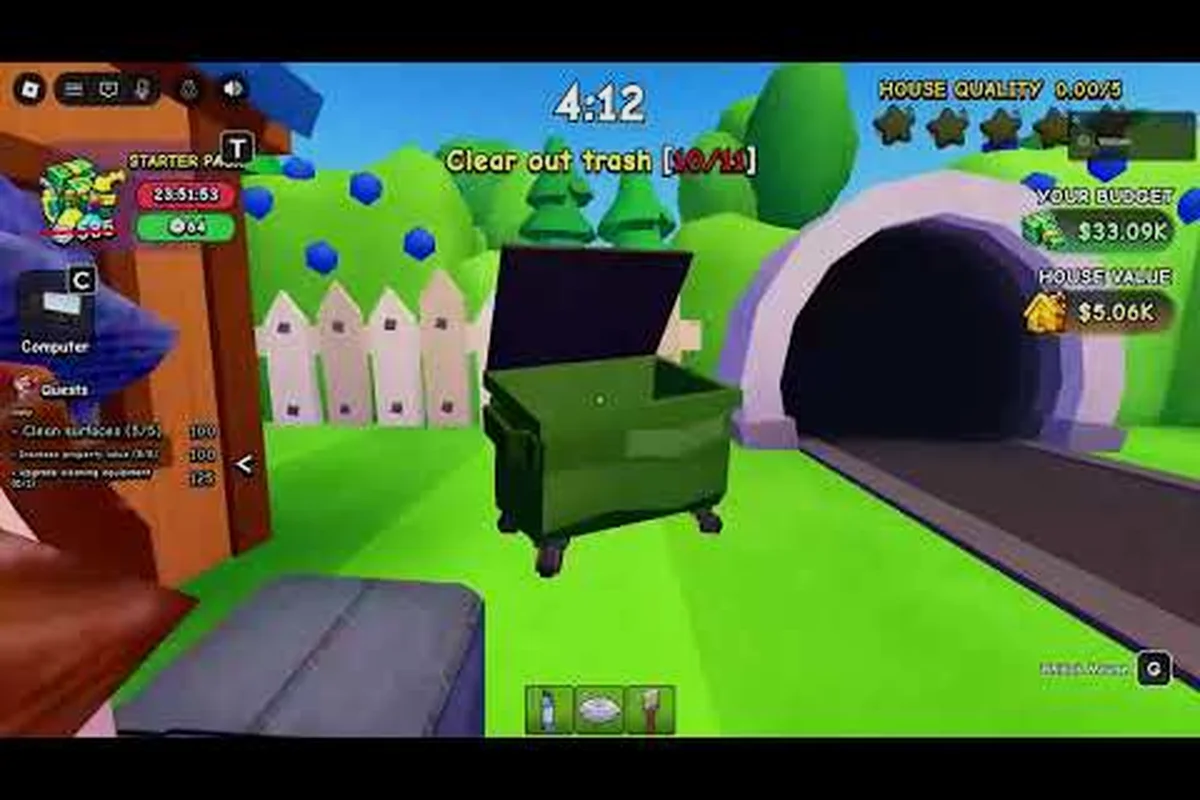
The fastest way to turn a messy first property into a reliable profit machine is to stop guessing and start following a repeatable cleaning sequence. These flip a house roblox tips cut through the trial-and-error phase that stalls most new players, because the game rewards surface coverage and speed far more than random scrubbing. You can hit your first profitable sale within the opening hour once you understand what to do first and which habits actually move the payout bar.
What to Do First in Your Opening Run
Your first ten minutes in Flip a House determine whether the rest of the session feels smooth or like a constant cash struggle. The opening property throws you into a trashed interior with no tutorial hand-holding, so knowing the right starting order saves you from wasting time on low-value surfaces while the clock ticks. Community gameplay recordings, including a Thai-language first-property run by Araimairu, consistently show the same early pattern: clear trash first, then scrub surfaces, then sell. The official Flip a House game page confirms the core loop is cleaning and reselling, which means every action should feed that cycle.
The Opening Sequence That Works
Start with trash pickup across the entire floor before touching any cleaning tool. Loose garbage blocks your movement and hides surface prompts, so removing it first gives you a clean path and reveals every interactive spot. Next, grab the starter sponge and work wall-to-wall in a clockwise sweep, because the surface counter fills as each surface type is completed rather than as individual spots are cleaned. Finally, check the sale prompt only after the counter shows full coverage, since listing early locks in a lower payout.
| Step | Action | Why It Matters |
|---|---|---|
| 1 | Clear all floor trash | Unblocks movement and reveals surface prompts |
| 2 | Scrub walls clockwise | Completes surface types in a predictable order |
| 3 | Finish floors last | Floors are the largest surface and take the longest |
| 4 | Check sale prompt | Only list after full coverage for maximum payout |
The opening hour is not about perfection. It is about learning how the surface counter behaves, because that single mechanic drives every payout decision you will make for the next fifty properties. Once you internalize the trash-to-scrub-to-sell rhythm, the rest of the game opens up.
How to Improve Fast Through Cleaning Habits
Improving quickly in Flip a House comes down to one thing: reducing the number of passes you make over the same surface. New players tend to scrub randomly, which means they revisit the same wall three times while missing an entire ceiling corner. The fix is a fixed route habit that turns every property into a predictable loop, and that habit is what separates a noob from a pro within a few hours of playtime.
Build a Repeatable Cleaning Route
A repeatable route means you always clean in the same spatial order: ceiling, walls, floors, then furniture. This order matters because ceiling stains are the easiest to miss when you rush, and missing them forces a second full pass. The beginner guide to Flip a House breaks down the core loop in more detail, but the short version is that consistency beats intensity. Players who clean the same way every time report finishing properties noticeably faster than those who improvise, based on community testing.
| Habit | New Player Behavior | Pro Behavior |
|---|---|---|
| Route order | Random scrubbing | Fixed ceiling-to-floor sequence |
| Trash handling | Picks up trash mid-scrub | Clears all trash before any scrubbing |
| Surface checking | Revisits missed spots repeatedly | Completes each surface type in one pass |
| Sale timing | Lists as soon as possible | Waits for full coverage confirmation |
The second habit that accelerates improvement is tool switching discipline. Do not carry the sponge into a room that needs the mop, because swapping tools mid-surface wastes seconds that compound across a full house. Learn which tool each surface type requires, then batch same-tool surfaces together so you are not constantly cycling through your inventory. This is a small optimization that feels trivial at first, but it is the difference between a 12-minute clear and a 9-minute clear on larger properties.
The Best Way to Start Building Cash Flow
Cash flow in Flip a House does not come from chasing the biggest, dirtiest property you can find. It comes from volume on small properties early, because the payout curve rewards completed sales more than partial progress on expensive homes. The best way to start is to flip three or four cheap properties in the time it would take you to half-clean one premium listing, since each completed sale adds to your tool budget and unlocks better gear.
Early Property Selection Strategy
Choose properties with low surface counts and compact layouts for your first ten flips. These homes finish faster, which means you see the sale screen more often and build muscle memory for the full loop. Avoid properties with multiple floors or sprawling basements until you have upgraded your movement speed and cleaning tools, because those layouts punish slow routing. The money guide for Flip a House covers payout optimization in depth, but the early-game rule is simple: speed of completion beats raw property value.
| Property Type | Early Game Value | Reason |
|---|---|---|
| Small single-floor | High | Fast completion, frequent sales |
| Medium two-floor | Medium | Longer routes, higher payout ceiling |
| Large multi-room | Low early | Slow clears stall your cash flow |
| Premium listings | Avoid until upgraded | High time cost per dollar earned |
Reinvest your first earnings into movement speed and tool durability before anything cosmetic. A faster character completes the same property in less real time, which directly increases your hourly cash rate. Tool durability matters because a broken sponge mid-property forces a trip back to the store, and that interruption kills your rhythm. The power potion guide explains how tool upgrades and durability interact, but the takeaway for new players is that functional upgrades always beat visual ones.
Noob to Pro: The Skill Progression Path
The journey from noob to pro in Flip a House is not about unlocking a secret tool or finding an exploit. It is about compressing the time between actions at every stage of the cleaning loop. A noob spends seconds deciding what to do next; a pro already knows because the route is internalized. A noob walks back and forth across the same room; a pro cleans in one continuous motion without backtracking. These micro-efficiencies stack into minutes saved per property.
The Three Skill Tiers
| Tier | Defining Behavior | Typical Clear Time |
|---|---|---|
| Noob | Random scrubbing, frequent backtracking | 15-20 minutes |
| Intermediate | Fixed route, some tool batching | 10-14 minutes |
| Pro | One-pass cleaning, zero backtracking | 7-9 minutes |
The jump from noob to intermediate happens when you commit to a fixed route and stop improvising. The jump from intermediate to pro happens when you eliminate backtracking entirely, which requires knowing exactly which surfaces remain before you enter a room. That awareness comes from repetition, but you can accelerate it by mentally checking off surface types as you complete them rather than relying on the on-screen counter alone.
Practice With Intent
Do not just grind properties mindlessly. After each sale, ask yourself where you lost the most time, then target that specific weakness on the next flip. If you spent thirty seconds hunting for a missed ceiling stain, focus on ceiling coverage next run. If you walked past the same trash pile three times, commit to clearing all trash before touching any cleaning tool. This deliberate practice loop is what turns ten hours of casual play into genuine skill improvement, because you are always working on your weakest link instead of repeating what you already do well.
Advanced Efficiency: Cutting Seconds Everywhere
Once you have the basic loop down, the next layer of improvement comes from shaving seconds off every transition. These are not glamorous changes, but they compound hard across a full flipping session. The goal is to make every movement purposeful, every tool swap instant, and every sale decision automatic.
Transition Optimization Table
| Transition | Time Wasted by Noobs | Pro Fix |
|---|---|---|
| Entering a room | 3-5 seconds deciding where to start | Route dictates first surface automatically |
| Swapping tools | 2-4 seconds scrolling inventory | Batch same-tool surfaces together |
| Checking coverage | 5-10 seconds walking to counter | Glance at counter while moving to next surface |
| Listing for sale | 10-20 seconds hesitating on price | List immediately at full coverage |
The biggest single win is eliminating the coverage check walk. New players finish scrubbing, then walk back to the counter to see if they missed anything, then walk back to the missed spot. Pros check the counter while already moving toward the next surface, so the information arrives without a dedicated trip. This requires knowing your route well enough to predict coverage before you look, but it is a learnable skill that pays off on every single property.
Frequently Asked Questions
What is the best way to start in Flip a House?
Clear all floor trash before touching any cleaning tool, then scrub surfaces in a fixed ceiling-to-floor order. This reveals every interactive prompt and prevents missed spots that force a second pass. List the property only after the surface counter shows full coverage to lock in the highest payout.
How do I improve fast as a new player?
Commit to a repeatable cleaning route and stop improvising. Batch same-tool surfaces together so you are not constantly swapping between sponge and mop. Reinvest early earnings into movement speed and tool durability, because faster clears and fewer interruptions directly increase your hourly cash rate.
What should I do first on a new property?
Always start with trash pickup across the entire floor. Loose garbage blocks movement and hides surface prompts, so removing it first gives you a clean path and reveals every interactive spot. Then begin your fixed cleaning route without hesitation, because the opening minutes set the pace for the whole flip.
How long does it take to go from noob to pro?
Most players reach intermediate level within three to five hours of focused play once they commit to a fixed route. Reaching pro-level efficiency, where you clean with zero backtracking, typically takes ten to fifteen hours of deliberate practice. The key is targeting your weakest link after each sale rather than grinding mindlessly.
Do expensive properties give better payouts for beginners?
Not early on. Small single-floor properties complete faster, which means you see the sale screen more often and build cash flow through volume. Large multi-room homes punish slow routing and stall your earnings until you have upgraded movement speed and tool durability.